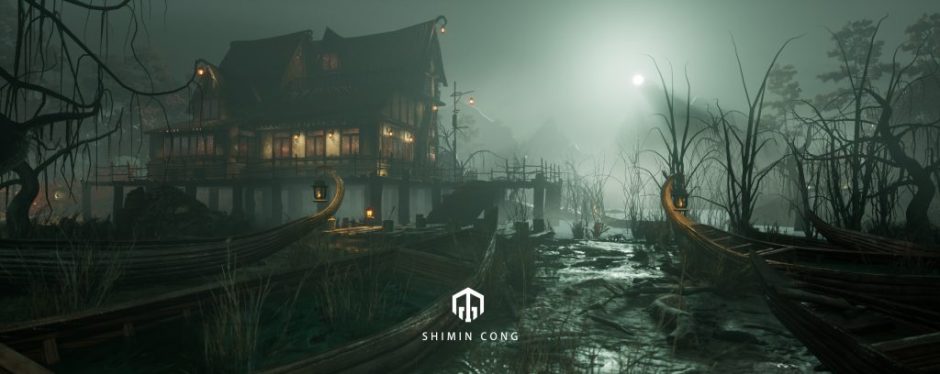
The lighting course is crucial to the quality improvement of art projects. Before that, I taught myself the Arnold renderer and Unreal’s real-time rendering system. And made some scenes related to lighting. But there is no systematic teaching.
The following is my combing of the knowledge points of the course and the lighting analysis in my three favorite films.
The role of lighting TD in VFX- Responsibilities:
- Assemble all the CG Assets in the shot from the upstream departments
- Design and implement lighting setup in shot to meet supervisor’s art direction
- Create production quality CGI with optimal render settings in respect to resources available
- Provide compositing team with the CG render elements required to deliver the shot
Skill requirements:
Understanding real-world/ studio lighting and photography
Help the artist to understand the motivation of the lighting design on-set and analyze the lighting methodically in order to replicate the look in CG.
Three-Point Lighting
- Key light: The main source of light in the shot.
- Fill light: The light fills into the key light’s shadow area
- Rim light:For separating the subject from the background

Lighting Ratio
- Stop value is measurement unit of the exposure.
- +1 stop : Doubling the amount of light
- -1 stop : Halving the amount of light
- The ratios of the stop value of the subject’s Key side to Fill side.
- For describing the lighting contrast.
Therefore, it can be divided into the following lighting methods according to the rate:
- High-Key lighting:
- The stop difference between the subject’s Key side and Fill side is subtle.
- Low contrast ratio.
- Low-Key lighting:
- The stop difference between the subject’s Key side and Fill side is distinctive
- High contrast ratio
Lighting Modifiers :
- Reflector is used for bouncing light into the shadow side to lower the contrast.
- Flag is used to block the unwanted light on the subject to increase the contrast.
Quality of Light Source
- Hard light:
- Sharp transition between the Light and Shadow on the subject.
- Created by a single point of light which is focusing on the subject. For example: Spot light.
- Soft light:
- Smooth transition between the Light and Shadow on the subject.
- Created by:
- Large light source
- Light Diffuser
- Bounce light
Color Temperature
- Color contrast between different light sources helps to shape the subject.
- Interior vs Exterior
- Time in the day
Artificial lights vs Natural lights: Indicate whether it is an interior light source or from outdoors.
Natural light variation throughout the day : To suggest the time of day
Creative Setup
Gobo lighting: Placing an object between the light source and subject in order to project it’s pattern / colour on the subject.
Catchlight: The bright reflection in the eyes might naturally occur when the corneas reflect the light source. In some cases It would also be added with extra light / reflector to meet the DOP’s art direction.
Identifying those techniques from the plate / reference and re-create the CG lighting:
- Three-Point Lighting —————> Position and the direction of different light sources.
- High-key and Low-key Lighting —> The contrast ratio of the Key and Fill on the subject.
- Hard and Soft Lighting ————–> Transition from the Light area to the Shadow area.
- Colour Temperature —————–> Define the time and space of shot is taking place in the story.
- Creative Lighting ———————> Adding complexity to the lighting of the image
Knowledge in Physically-Based Rendering
Simulating light
Behaviors of light on different material
Method to Generate image
Path Tracing
Light Sources
CG lights:
- Direct light- can be used as the main light source
- point light- often used in rich scenes, high performance consumption
- sopt light- analog spotlight
- Quad light- fill light commonly used, the effect is the best, the performance consumption is the largest
Image-Based Lighting (IBL)
HDR map- often used as ambient light to supplement shadows
Problem-solving ( from the Pipeline point of view )
- Environment
- Crowd
- FX
These three problems are the biggest problems encountered in rendering, and rendering takes a lot of time. Therefore, layered rendering and scene optimization are crucial.
Scripting ability ( what I need to learn)
- Many VFX applications like Maya / Houdini support scripting language to provide artists powerful controls in asset creation / scene setup / pipeline etc.
- As the VFX project is getting huge and complex nowadays, sometime it is the only practical way to perform the setup.
Lighting analysis
This picture is a picture in Lord of the Rings. This screen uses the lighting method of 2 point light sources. The right side is the main light source. In addition, because it is a close-up shot of the character, an auxiliary light source is needed to target the eyeball before rendering. As for Color Temperature, natural light at night is used. The overall method is low key light.
This scene uses 3 point light sources. Among them, the main light source is in the upper right corner, and the fill light is in the lower left corner. The background of the war gave Iron Man a backlight. On the whole, Lighting Ratiois 1/5.
Due to the extensive use of special effects, including light effects and smoke, a layered rendering synthesis method may be used in the rendering.
This is a street view in Alita. In this picture, the main light source is on the back of the character. Lighting Ratio is 1/3. In addition, Color Temperature is to simulate the sunlight at noon.